Introduction:
In the pursuit of excellence, no improvement is too small.
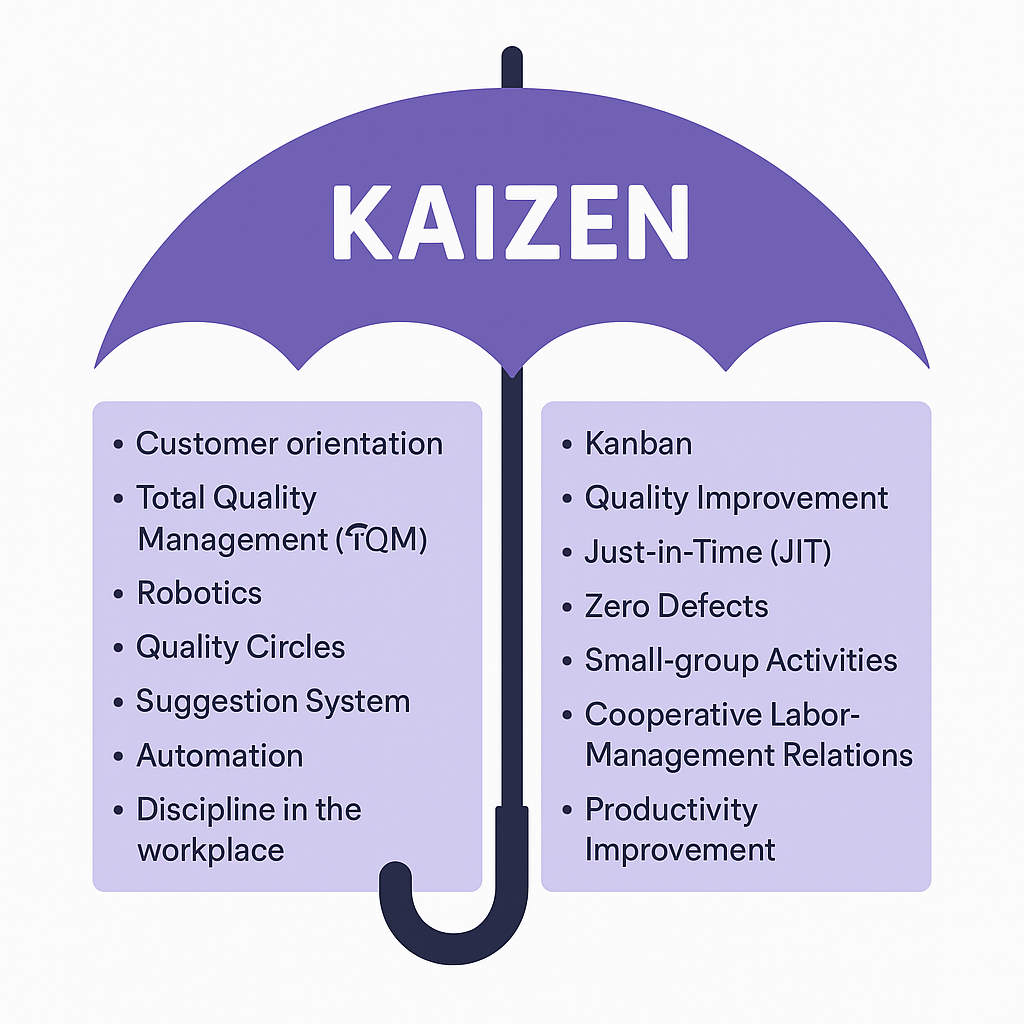
That’s the philosophy behind Kaizen (改善) — a core pillar of Lean thinking and a powerful cultural mindset that fuels sustainable growth in every aspect of a business. Originating from Japan and embraced worldwide, Kaizen means “change for the better”. But its real strength lies in small, consistent, and people-driven improvements that compound over time.
Let’s dive deep into the essence, methodology, and impact of Kaizen — and how you can apply it in your workplace.
What is Kaizen?
Kaizen (改善) combines two Japanese words:
- Kai (改) – Change
- Zen (善) – Good or for the better
Together, it represents a philosophy of continuous improvement through incremental changes rather than dramatic overhauls.
Kaizen isn’t just a tool — it’s a mindset and culture that empowers employees at every level to identify problems, suggest solutions, and take action.
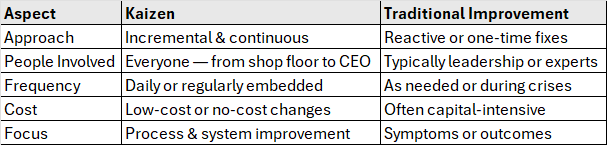
Kaizen vs. Traditional Problem-Solving
Types of Kaizen in Practice
- Daily Kaizen : Small process improvements suggested and implemented by employees during regular work.
- Kaizen Events (or Blitz) Short-term, focused workshops (1–5 days) where cross-functional teams tackle a specific problem or area.
- Kaizen Circles: Small groups of employees that meet regularly to identify improvement opportunities and execute changes together.
Kaizen Implementation: 6-Step Method
Here’s a practical step-by-step flow for executing a Kaizen improvement:
- Identify the Problem or Opportunity Use data, observation, or feedback to find improvement areas.
- Analyze the Current Process : Use tools like VSM, 5 Whys, or Fishbone Diagrams.
- Generate Improvement Ideas: Brainstorm low-cost, simple ideas with frontline teams.
- Implement the Change: Test the solution in a controlled way (e.g., pilot area or trial run).
- Measure Results : Track metrics like lead time, cycle time, waste reduction, or defect rate.
- Standardize and Repeat: If successful, document and standardize the new method. Then move to the next improvement.
Kaizen and Lean Principles
Kaizen directly supports several Lean manufacturing principles:
| Lean Principle | Kaizen Alignment |
|---|---|
| Waste Elimination | Encourages everyone to find and reduce Muda |
| Respect for People | Empowers workers to drive improvement |
| Continuous Flow | Improves flow through small process tweaks |
| Visual Management | Makes improvements visible and measurable |
| Standardized Work | Builds consistent processes after changes |
Benefits of Kaizen
- Boosts employee morale and engagement
- Reduces waste and operational costs
- Improves quality and consistency
- Fosters a culture of collaboration
- Encourages innovation from the bottom up
- Accelerates Lean transformation
- Increases responsiveness to market/customer needs
Real-World Example: Kaizen in Action
At a precision machining company, operators noticed that switching tool bits took 3–5 minutes per part.
Using a Kaizen approach, they:
- Suggested a nearby tool holder and magnetic tray
- Reduced search time and hand movement
- Standardized the layout for every workstation
Result? Tool changeover time dropped to under 60 seconds — and was replicated across 14 machines.
Cost? Less than $50 per station.
Impact? Massive — both in time savings and operator confidence.
Common Kaizen Challenges and How to Overcome Them
| Challenge | Solution |
|---|---|
| Resistance to change | Celebrate small wins and involve teams |
| No time for improvement | Integrate Kaizen into daily routines |
| Poor follow-through | Assign ownership and track results |
| Lack of ideas | Provide examples and run Kaizen events |
| No leadership buy-in | Show ROI with simple pilot improvements |
Kaizen Tools That Support Execution
- 5 Whys
- PDCA Cycle (Plan-Do-Check-Act)
- Value Stream Mapping
- Fishbone (Ishikawa) Diagram
- Pareto Analysis
- A3 Problem Solving Sheets
- Standard Work Combination Sheets
Conclusion: Kaizen is a Culture, Not a Project
Kaizen is not about perfection — it’s about progress, made daily.
When everyone from operators to leaders is encouraged to think critically, act boldly, and continuously improve, real transformation begins.
You don’t need a massive budget.
You need mindset, discipline, and belief in people.
💡 Start with small steps. Repeat daily. Let Kaizen drive your excellence.